MamoriConcept

Concept only · working name · not for sale

Quiet care
at home.

Mamori is a concept for a small tabletop device for an older relative’s home. It is designed to offer a big help button, read the room air, and keep its microphone off unless you can see that it is on. There is no camera.

Concept drawing of the Mamori device: an arch-shaped body with an orange button on top, a small display, a mic shutter, and a ring light at the base

Private: green ring (design intent: the mic would have no power)

  • 0cameras
  • 0image sensors
  • 4ring-light states
  • 1big help button
  • ~90 mmacross (about)
  • No camera
  • No image sensor
  • Mic LED designed on the mic’s power line
  • Shutter would cut the mic and calls
  • Big help button
  • Room air, not health data
  • Sound would not be stored
  • Not a medical device

The idea

Five things it is designed to do

Each one is a design intent, not a tested result. The limits sit right next to the promise.

1 Emergency warning

One big button, a local alarm

A press would sound an alarm in the room, turn the ring red and show “Help called”. If a family node is paired, it would send an alert there too.

Limit: only helps if the button can be reached. It is not an emergency service and there is no guaranteed response.

2 Living signals

Room air, in plain words

PM2.5, CO2 and VOC, temperature and humidity, shown as simple notes like “air looks stale”. Blood oxygen would be only through an optional contact accessory, with no claim.

Limit: room air readings, not health measurements. No claim about blood oxygen.

3 Fall alert, from a partner

Passed on, not sensed

Mamori has no fall sensor. A partner’s own wifi sensing box could raise a fall-event signal; Mamori is designed to pass it on to the paired node.

Limit: not validated. It may miss real events or raise false ones.

4 Optional call

Talk to family, visibly

Designed to call another paired node over the internet. The ring would pulse amber and the display would say a call is on.

Limit: designed to be off while the shutter is closed. Not an emergency call line.

5 Full privacy

No camera. A light you can check.

No camera and no image sensor in the concept. The mic LED is designed to sit on the mic’s power line, so no light would mean no mic. A slider would cover the mic and cut its power.

Limit: the circuit would need an independent check before anyone relies on it.

Sensor map

Tap a part to see what it would do

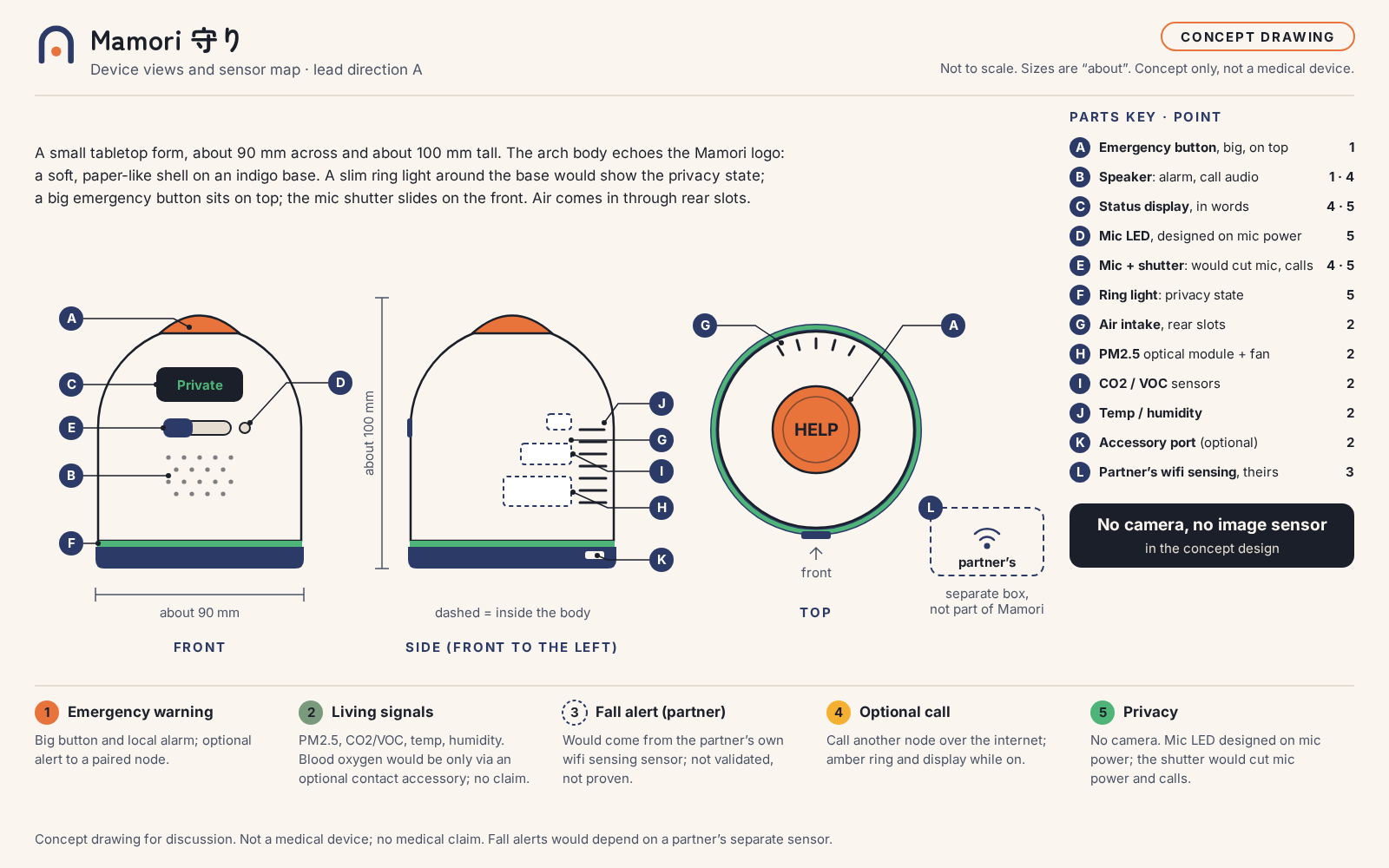
About 90 mm across and about 100 mm tall. Letters match the concept drawing.

APoint 1 · Emergency warning

Emergency button

A big physical button on top. A press would sound a local alarm, turn the ring red and show “Help called” on the display. If a family node is paired, it would also send an alert there.

Honest limit: only works if the person can reach and press it. It is not an emergency service; there is no guaranteed response.

The full concept drawing: front, side and top views (PNG) · vector (SVG)

Privacy, by hardware

Four states, always visible

Try it. The ring, the mic LED and the shutter tell the same story. This is a live demo of the design intent; nothing here uses your microphone.

The concept device showing the privacy state chosen with the controls
Device state
Ring
Green, steady
Mic LED
Off
Shutter
Closed: mic covered (design intent: no power)
Sound
None

Private. The microphone would have no power.

No camera. No image sensor. Anywhere.

The concept has no camera or image sensor, so it is designed to make no images. Sound would not be stored. The partner’s wifi sensing box is a separate device with its own privacy terms, which this concept does not control.

How it would work

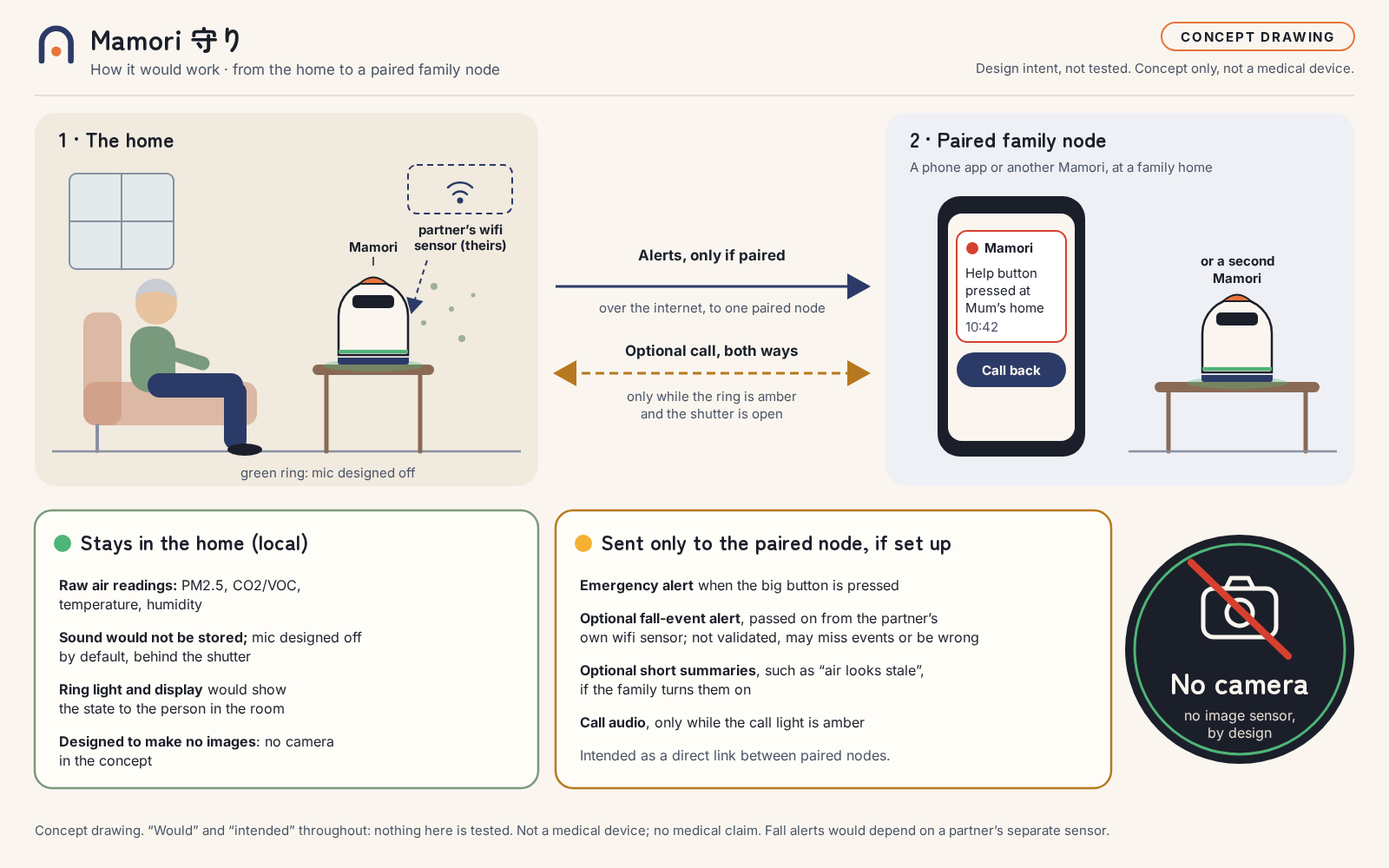
From the home to one paired family node

A direct link between paired nodes is the intent. If nothing is paired, everything stays in the room.

Partner’s wifi sensora separate box, theirs

Mamori, at homegreen ring: mic designed to be off

Paired family nodea phone app or a second Mamori

  • Alerts, only if paired: the help button, and an optional fall-event signal passed on from the partner’s sensor.
  • Optional call, both ways: designed to run only while the ring is amber and the shutter is open.
  • Partner’s signal: comes from their own sensor; not validated, may miss events or be wrong.

Stays in the home

  • Raw air readings: PM2.5, CO2/VOC, temperature, humidity
  • Sound would not be stored; mic designed to be off by default, behind the shutter
  • Ring light and display show the state to the person in the room
  • Designed to make no images: the concept has no camera

Sent only to the paired node, if set up

  • Emergency alert when the big button is pressed
  • Optional fall-event alert, passed on from the partner’s own sensor; not validated
  • Optional short summaries, such as “air looks stale”
  • Call audio, only while the call light is amber
Concept drawing: an older person at home with Mamori on a side table and the partner's separate wifi sensor; alerts are designed to go only to a paired family node, a phone app or a second Mamori; an optional call works both ways only while the ring is amber
The one-page diagram. Open the vector drawing. Swipe sideways to see it all.

Living signals

Calm notes about the room

A mock of what the paired node might show. Plain words first, numbers second.

Living room · mock screen

Example values · illustrative only · not live data

Air looks a little stale. Opening a window could help.

PM2.5

12 µg/m³

Looks clear

CO2

840 ppm

A little stale

VOC

Low

Nothing to note

Temperature

22.5 °C

Comfortable

Humidity

48 %

Comfortable

Blood oxygen

No value

Only with an optional contact accessory, which would need its own separate validation. No claim is made.

These are room air readings, not health measurements. Low-cost sensors drift and need calibration; a spot near a heater skews them.

Honest answers

What it is, and what it is not

Is Mamori a medical device?

No. It is a concept, not a medical device, and it makes no medical claim. It would not replace a doctor, a carer or an emergency service.

Does it detect falls?

Mamori itself has no fall sensor. The idea is that a partner’s own wifi sensing sensor, a separate box, could raise a fall-event signal, and Mamori would pass it on to the paired node. That has not been validated: it may miss real events or raise false ones, and how well it works would depend on the partner’s sensor, the room and the setup.

Is there a camera?

No. The concept has no camera and no image sensor, so it is designed to make no images to store or send.

Could the microphone listen without anyone knowing?

The design intent is no: the mic LED would be wired on the mic’s power line, so the mic would not be able to work without the light on, and a sliding shutter would cover the mic and cut its power. This hardware rule would need an independent check of the circuit before anyone relies on it. Sound would not be stored.

If the button is pressed, will help come?

Not guaranteed. A press would sound a local alarm, which helps only if someone can hear it, and would send an alert to a paired family node if one is set up and the power and internet link work. It is not an emergency service.

Does it measure health?

It would read the room air: PM2.5, CO2/VOC, temperature and humidity. Those are not health measurements. Blood oxygen would only come from an optional contact accessory that would need its own separate validation; no claim is made about it.

Can I buy it, or sign up?

No. This is a concept for discussion. There is nothing for sale, no account and no paid service. Mamori is a working name and has not been trademark-checked.